World Info Hub - We Are All Connected - The Whole World is Watching - It Is Bigger Than Us - Be the Change

PEACE - LOVE - FREEDOM - INFORMATION - RΞ√ΩLUT↑☼N - ADAPT - OVERCOME - RISE ABOVE - EDUCATE - MOTIVATE - INSPIRE

Exercising the Right to freedom of thought, belief, opinion and expression, including freedom of the press and other media of communication

Loading
--- If you would like to post front page articles on chaoticfate.com register here

Sunday, March 27, 2011

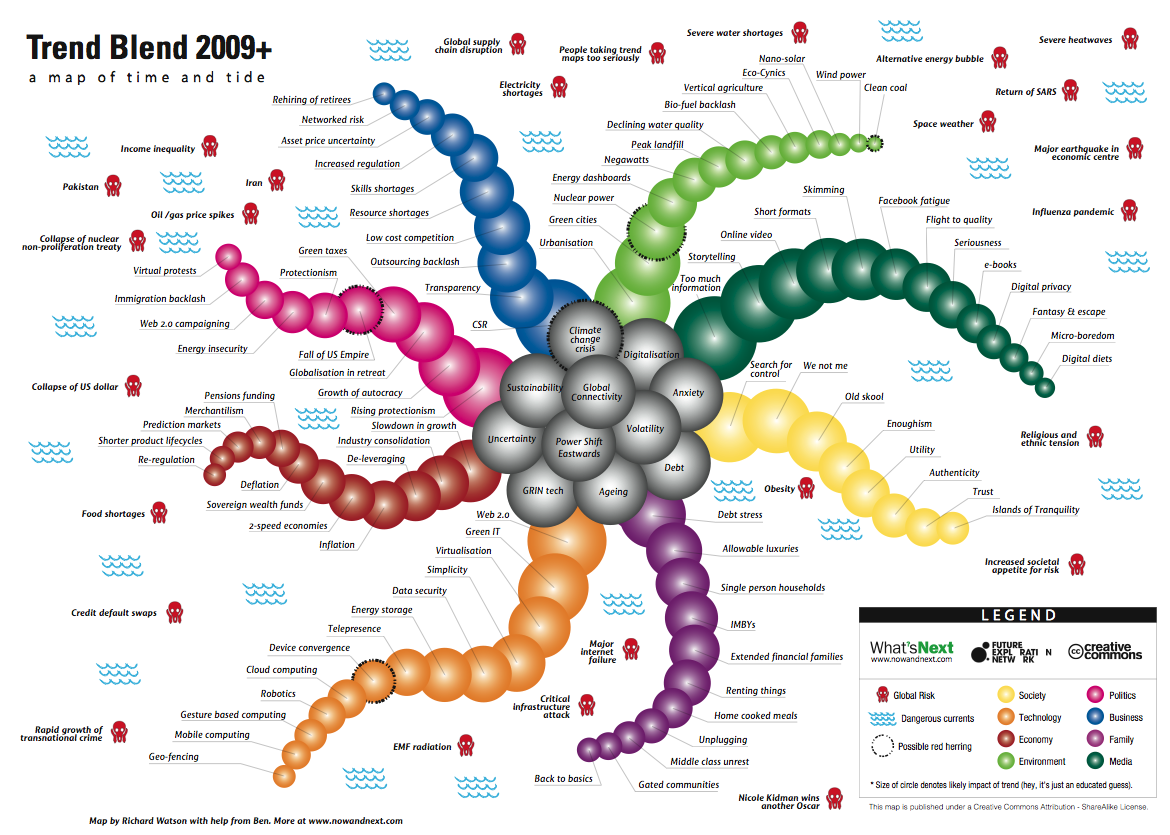
Ever Wonder WHY a Trend is Trending on Twitter?

from Chaotic Fate by qew


Travis Wright | Jan 28, 2010 | Comments (0)


http://mobilelocalsocial.com/2010/ever-wonder-why-a-trend-is-trending-on-twitter/

Every once in awhile, you look down at the trending topics on twitter and wonder why in the hell this is trending. Sometimes, it’s a European thing. Sometimes, it’s a completely random WTF type thing. So, in case you would like to know WHY this particular meme is trending on twitter at any given time, you can check out WhatTheTrend.

What the Trend helps you find out what’s trending on Twitter and why. They are supposedly “The front page of the real-time web™. For each trend, they give you a quick explanation of WHY it’s trending (these blurbs are edited by you.)
With its “Digg-like” user interface, they are currently tracking 56,797 explanantions for 25,514 trends. I find this an interesting resource to check out during my social media adventures… perhaps you will, as well.
You may also be interested in the 2009 Top Trends of the Year.

Radiation levels at Japan nuclear plant reach new highs

from Chaotic Fate by qew

http://www.washingtonpost.com/world/radiation-levels-reach-new-highs-as-conditions-worsen-for-workers/2011/03/27/AFsMLFiB_story.html


Gallery: Japan’s nuclear crisis: Japan battles to prevent a nuclear catastrophe and to care for millions of people without power or water in its worst crisis since World War II.
TOKYO — Already-grave conditions at the Fukushima Daiichi nuclear plant worsened Sunday with the highest radiation readings yet, compounding both the risks and challenges for workers trying to repair the facility’s cooling system.
Video

Japan's government revealed a series of missteps by the         operator of a radiation-leaking nuclear plant on Saturday,         including sending workers in without protective footwear in its         faltering efforts to control a monumental crisis. (March 26)
Video: Japan's government revealed a series of missteps by the operator of a radiation-leaking nuclear plant on Saturday, including sending workers in without protective footwear in its faltering efforts to control a monumental crisis. (March 26)
Leaked water sampled from one unit Sunday was 100,000 times more radioactive than normal background levels — though the Tokyo Electric Power Co., which operates the plant, first calculated an even higher, erroneous, figure that it didn’t correct for several hours.
Tepco apologized Sunday night when it realized the mistake; it had initially reported radiation levels in the leaked water from the unit 2 reactor as being 10 million times higher than normal, which prompted an evacuation of the building.
After the levels were correctly measured, airborne radioactivity in the unit 2 turbine building still remained so high — 1,000 millisieverts per hour — that a worker there would reach his yearly occupational exposure limit in 15 minutes. A dose of 4,000 to 5,000 millisieverts absorbed fairly rapidly will eventually kill about half of those exposed.
The latest confusion in the operation to stave off a full-scale nuclear meltdown at the crippled facility underscores the immense challenges for the several hundred workers in a desperate battle to restart the critical cooling systems. Seventeen workers have been exposed to high levels of radiation, including three who were hospitalized last week, as technicians conducted highly nuanced electrical work in dark conditions that one nuclear industry expert termed “hellish.”
Japanese authorities say efforts to control Fukushima’s overheated reactors will take months and during that time radiation will continue to leak into the environment, extending a nuclear emergency that already ranks as the world’s most serious in a quarter-century. Several hundred workers now shoulder the responsibility for limiting the crisis, amid potentially lethal radiation levels, and on Saturday the chief of Japan’s nuclear agency called on Tepco to improve its worker safety.

The dangers in unit 2 merely add to the growing challenges. Radioactive water is pooling in four of Fukushima’s six turbine rooms and engineers have no quick way to clean it up, although they have begun efforts to do so in unit 1.Evidence of rising contamination in and around the plant has tempered optimism from one week ago, when engineers began work to restore power to the first of the damaged reactor buildings. Japan’s Nuclear and Industrial Safety Agency said Sunday that a new measurement of seawater taken about 1,000 feet from the facility showed an iodine level 1,850.5 times the legal limit, higher than a reading taken the previous day.
While a Tepco spokesperson said Sunday he did not know how the radioactive water was leaking from the reactor cores, Yukio Edano, chief cabinet secretary, said in a televised interview Sunday morning that the reactor itself had not been breached.
He said it was clear that water that could have been inside the unit 3 reactor had leaked, but said the reactor had not been breached. Still, he said that “unfortunately, it seems there is no question that water, which could have been inside the reactor, is leaking.’’
Unlike in newer reactor designs, the older boiling water reactors at Daiichi are pierced by dozens of holes in the bottom of their reactor vessels. Each hole allows one control rod — made of a neutron-absorbing material that quickly stops nuclear fission inside the reactor — to slide into the reactor from below, as happened when the earthquake shook the plant March 11. During normal operations, a graphite stopper covers each hole, sealing in highly radioactive primary cooling water, said Arnie Gundersen, a consultant at Fairewinds Associates with 40 years of experience overseeing boiling water reactors.
But at temperatures above 350 degrees Fahrenheit, the graphite stoppers begin to melt.
“Since it is likely that rubble from the broken fuel rods . . . is collecting at the bottom of the reactor, the seals are being damaged by high temperature or high radiation,” Gundersen said. As the graphite seals fail, water in the reactor will leak into a network of pipes in the containment buildings surrounding each reactor — the very buildings that have been heavily damaged by explosions. Gundersen said that this piping is probably compromised, leaving highly radioactive water to seep from the reactor vessels into broken pipes — and from there into the turbine buildings and beyond.
To stabilize the facility, workers are trying to repair the elaborate cooling system, necessary to keep the reactor cores and spent fuel pools from overheating. But for the moment, they are conducting this work in dark, steamy conditions. Workers must wear respirators, face masks and bulky suits. Nuclear safety experts say they must shift out of the most dangerous areas every 30 minutes to an hour, to prevent radiation overexposure.
Meantime, they’re racing to repair motor pumps the size of automobiles. Their environment resembles a cavern of cables. Some of the equipment was damaged during the March 11 earthquake and tsunami. Other equipment has been corroded by saltwater, which was poured into the facility during earlier efforts to cool the reactors.
“To a layman, you’d be scared to death,” said Lake Barrett, a nuclear engineer who directed the cleanup of Three Mile Island. “You’re working with saltwater around your feet. This is not the way electricians usually work.”
The number of workers at the Fukushima plant fluctuates from day to day, ranging between 500 and 1,000. But Tepco employees account for only a part of the labor force. Last Tuesday, for instance, there were 700 people at the plant, a nuclear agency official said. The figure included 500 Tepco employees, 100 subcontracted workers and 100 members of Japan’s Self Defense Forces or the Tokyo Fire Department.
One subcontracted worker who laid cables for new electrical lines March 19 described chaotic conditions and lax supervision that made him nervous. Masataka Hishida said neither he nor the workers around him were given a dosimeter, a device used to measure one’s exposure to radiation. He was surprised that workers were not given special shoes; rather, they were told to put plastic bags over their street shoes. When he was trying on the gas mask for the first time, he said the supervisor told him and other subcontractors, “Listen carefully, I’m only going to say this one time” while explaining how to use it.
When Hishida finished his work shift, an official scanned his whole body for radiation. He came up clean, except for the very tip of his beard. He was sent into a shower where he lathered up and scrubbed his beard. He was tested again and passed.
A few days later, still worried about the extent of his radiation exposure, he trimmed his beard.
harlanc@washpost.com
Staff writers Michael Alison Chandler and David Nakamura and special correspondents Kyoko Tanaka, Akiko Yamamoto and Kato Tetsuya contributed to this report.

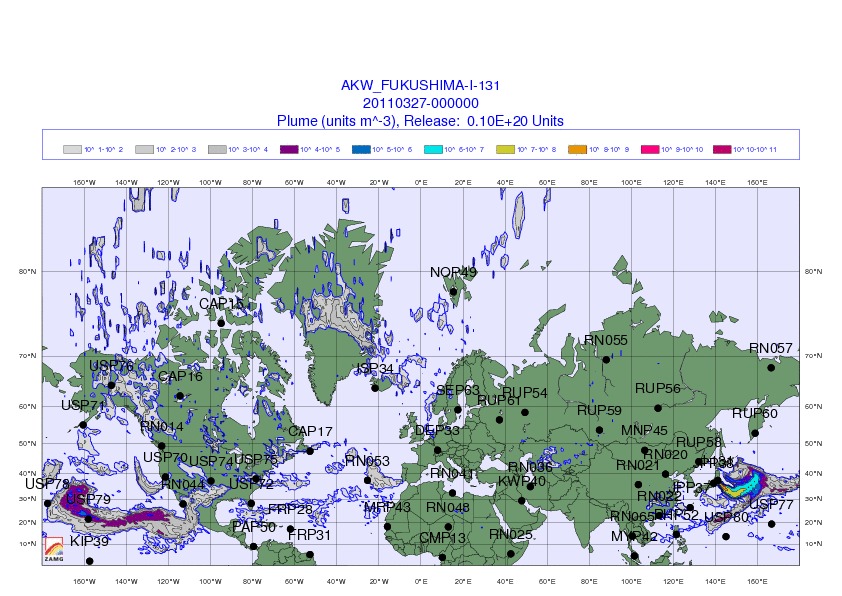
GoogleEarth Based 3D Map Of Real-Time Radioactivity Distribution In Japan; Projected Global Radioactivity Dispersion

from Chaotic Fate by qew

http://www.blacklistednews.com/?news_id=13240

March 27, 2011
Source: Zero Hedge
Confirming that in a time of instantaneous crowdsourced information distribution and analysis, any attempt by a government to institute an information blackout of any nature is doomed to failure, is the following amazing Google Earth-based 3D interactive map of Geiger readings from Japan. And if that is not enough, the Pachube community has released an extensive selection of crowd-sourced realtime radiation monitoring tools and widgets, focusing on as many Japanese territories as possible. Shortly we are confident all geographical holes will be filled, and every square mile of the affected territories will be mapped out surpassed the government’s “Under Survey” blackout attempts.
Make sure to have the GoogleEarth API set up in advance of checking out the plugin.
GoogleEarth Based 3D Map Of Real Time Radioactivity Distribution In Japan; Projected Global Radioactivity Dispersion  googlemap
Additionally, here is the most recent updated global radioactive fallout per ZAMG.
GoogleEarth Based 3D Map Of Real Time Radioactivity Distribution In Japan; Projected Global Radioactivity Dispersion  20110325 Reanalyse I131 Bild5 gr

New Shocking Video Of The Japanese Tsunami

An Empire of Lies: The CIA and the Western Media

from Chaotic Fate by qew


http://www.blacklistednews.com/An_Empire_of_Lies%3A_The_CIA_and_the_Western_Media/13247/0/5/5/Y/M.html


Contrary to its avowed aim, mainstream journalism invariably diminishes the impact of new events when they threaten powerful elites. 


Last week the Guardian, Britain’s main liberal newspaper, ran an exclusive report on the belated confessions of an Iraqi exile, Rafeed al-Janabi, codenamed “Curveball” by the CIA. Eight years ago, Janabi played a key behind-the-scenes role — if an inadvertent one — in making possible the US invasion of Iraq. His testimony bolstered claims by the Bush administration that Iraq’s president, Saddam Hussein, had developed an advanced programme producing weapons of mass destruction.

Curveball’s account included the details of mobile biological weapons trucks presented by Colin Powell, the US Secretary of State, to the United Nations in early 2003. Powell’s apparently compelling case on WMD was used to justify the US attack on Iraq a few weeks later.
Eight years on, Curveball revealed to the Guardian that he had fabricated the story of Saddam’s WMD back in 2000, shortly after his arrival in Germany seeking asylum. He told the paper he had lied to German intelligence in the hope his testimony might help topple Saddam, though it seems more likely he simply wanted to ensure his asylum case was taken more seriously.
For the careful reader — and I stress the word careful — several disturbing facts emerged from the report.

One was that the German authorities had quickly proven his account of Iraq’s WMD to be false. Both German and British intelligence had travelled to Dubai to meet Bassil Latif, his former boss at Iraq’s Military Industries Commission. Dr Latif had proven that Curveball’s claims could not be true. The German authorities quickly lost interest in Janabi and he was not interviewed again until late 2002, when it became more pressing for the US to make a convincing case for an attack on Iraq.

Another interesting disclosure was that, despite the vital need to get straight all the facts about Curveball’s testimony — given the stakes involved in launching a pre-emptive strike against another sovereign state — the Americans never bothered to interview Curveball themselves.
A third revelation was that the CIA’s head of operations in Europe, Tyler Drumheller, passed on warnings from German intelligence that they considered Curveball’s testimony to be highly dubious. The head of the CIA, George Tenet, simply ignored the advice.

With Curveball’s admission in mind, as well as these other facts from the story, we can draw some obvious conclusions — conclusions confirmed by subsequent developments.

Lacking both grounds in international law and the backing of major allies, the Bush administration desperately needed Janabi’s story about WMD, however discredited it was, to justify its military plans for Iraq. The White House did not interview Curveball because they knew his account of Saddam’s WMD programme was made up. His story would unravel under scrutiny; better to leave Washington with the option of “plausible deniability”.

Nonetheless, Janabi’s falsified account was vitally useful: for much of the American public, it added a veneer of credibility to the implausible case that Saddam was a danger to the world; it helped fortify wavering allies facing their own doubting publics; and it brought on board Colin Powell, a former general seen as the main voice of reason in the administration.
In other words, Bush’s White House used Curveball to breathe life into its mythological story about Saddam’s threat to world peace.

So how did the Guardian, a bastion of liberal journalism, present its exclusive on the most controversial episode in recent American foreign policy?

Here is its headline: “How US was duped by Iraqi fantasist looking to topple Saddam”.
Did the headline-writer misunderstand the story as written by the paper’s reporters? No, the headline neatly encapsulated its message. In the text, we are told Powell’s presentation to the UN “revealed that the Bush administration’s hawkish decisionmakers had swallowed” Curveball’s account. At another point, we are told Janabi “pulled off one of the greatest confidence tricks in the history of modern intelligence”. And that: “His critics — who are many and powerful — say the cost of his deception is too difficult to estimate.”

In other words, the Guardian assumed, despite all the evidence uncovered in its own research, that Curveball misled the Bush administration into making a disastrous miscalculation. On this view, the White House was the real victim of Curveball’s lies, not the Iraqi people — more than a million of whom are dead as a result of the invasion, according to the best available figures, and four million of whom have been forced into exile.

There is nothing exceptional about this example. I chose it because it relates to an event of continuing and momentous significance.

Unfortunately, there is something depressingly familiar about this kind of reporting, even in the West’s main liberal publications. Contrary to its avowed aim, mainstream journalism invariably diminishes the impact of new events when they threaten powerful elites.
We will examine why in a minute. But first let us consider what, or who, constitutes “empire” today? Certainly, in its most symbolic form, it can be identified as the US government and its army, comprising the world’s sole superpower.

Traditionally, empires have been defined narrowly, in terms of a strong nation-state that successfully expands its sphere of influence and power to other territories. Empire’s aim is to make those territories dependent, and then either exploit their resources in the case of poorly developed countries, or, with more developed countries, turn them into new markets for its surplus goods. It is in this latter sense that the American empire has often been able to claim that it is a force for global good, helping to spread freedom and the benefits of consumer culture.
Empire achieves its aims in different ways: through force, such as conquest, when dealing with populations resistant to the theft of their resources; and more subtly through political and economic interference, persuasion and mind-control when it wants to create new markets. However it works, the aim is to create a sense in the dependent territories that their interests and fates are bound to those of empire.

In our globalised world, the question of who is at the centre of empire is much less clear than it once was. The US government is today less the heart of empire than its enabler. What were until recently the arms of empire, especially the financial and military industries, have become a transnational imperial elite whose interests are not bound by borders and whose powers largely evade legislative and moral controls.

Israel’s leadership, we should note, as well its elite supporters around the world — including the Zionist lobbies, the arms manufacturers and Western militaries, and to a degree even the crumbling Arab tyrannies of the Middle East — are an integral element in that transnational elite.
The imperial elites’ success depends to a large extent on a shared belief among the western public both that “we” need them to secure our livelihoods and security and that at the same time we are really their masters. Some of the necessary illusions perpetuated by the transnational elites include:
 That we elect governments whose job is to restrain the corporations;
 That we, in particular, and the global workforce in general are the chief beneficiaries of the corporations’ wealth creation;
 That the corporations and the ideology that underpins them, global capitalism, are the only hope for freedom;
 That consumption is not only an expression of our freedom but also a major source of our happiness;
 That economic growth can be maintained indefinitely and at no long-term cost to the health of the planet;
 And that there are groups, called terrorists, who want to destroy this benevolent system of wealth creation and personal improvement.
These assumptions, however fanciful they may appear when subjected to scrutiny, are the ideological bedrock on which the narratives of our societies in the West are constructed and from which ultimately our sense of identity derives. This ideological system appears to us — and I am using “we” and “us” to refer to western publics only — to describe the natural order.

The job of sanctifying these assumptions — and ensuring they are not scrutinised — falls to our mainstream media. Western corporations own the media, and their advertising makes the industry profitable. In this sense, the media cannot fulfil the function of watchdog of power, because in fact it is power. It is the power of the globalised elite to control and limit the ideological and imaginative horizons of the media’s readers and viewers. It does so to ensure that imperial interests, which are synonymous with those of the corporations, are not threatened.
The Curveball story neatly illustrates the media’s role.

His confession has come too late — eight years too late, to be precise — to have any impact on the events that matter. As happens so often with important stories that challenge elite interests, the facts vitally needed to allow western publics to reach informed conclusions were not available when they were needed. In this case, Bush, Cheney and Rumsfeld are gone, as are their neoconservative advisers. Curveball’s story is now chiefly of interest to historians.

That last point is quite literally true. The Guardian’s revelations were of almost no concern to the US media, the supposed watchdog at the heart of the US empire. A search of the Lexis Nexis media database shows that Curveball’s admissions featured only in the New York Times, in a brief report on page 7, as well as in a news round-up in the Washington Times. The dozens of other major US newspapers, including the Washington Post, made no mention of it at all.

Instead, the main audience for the story outside the UK was the readers of India’s Hindunewspaper and the Khaleej Times.

But even the Guardian, often regarded as fearless in taking on powerful interests, packaged its report in such a way as to deprive Curveball’s confession of its true value. The facts were bled of their real significance. The presentation ensured that only the most aware readers would have understood that the US had not been duped by Curveball, but rather that the White House had exploited a “fantasist” — or desperate exile from a brutal regime, depending on how one looks at it – for its own illegal and immoral ends.

Why did the Guardian miss the main point in its own exclusive? The reason is that all our mainstream media, however liberal, take as their starting point the idea both that the West’s political culture is inherently benevolent and that it is morally superior to all existing, or conceivable, alternative systems.

In reporting and commentary, this is demonstrated most clearly in the idea that “our” leaders always act in good faith, whereas “their” leaders — those opposed to empire or its interests — are driven by base or evil motives.

It is in this way that official enemies, such as Saddam Hussein or Slobodan Milosevic, can be singled out as personifying the crazed or evil dictator — while other equally rogue regimes such as Saudi Arabia’s are described as “moderate” — opening the way for their countries to become targets of our own imperial strategies.

States selected for the “embrace” of empire are left with a stark choice: accept our terms of surrender and become an ally; or defy empire and face our wrath.

When the corporate elites trample on other peoples and states to advance their own selfish interests, such as in the invasion of Iraq to control its resources, our dominant media cannot allow its reporting to frame the events honestly. The continuing assumption in liberal commentary about the US attack on Iraq, for example, is that, once no WMD were found, the Bush administration remained to pursue a misguided effort to root out the terrorists, restore law and order, and spread democracy.

For the western media, our leaders make mistakes, they are naïve or even stupid, but they are never bad or evil. Our media do not call for Bush or Blair to be tried at the Hague as war criminals.

This, of course, does not mean that the western media is Pravda, the propaganda mouthpiece of the old Soviet empire. There are differences. Dissent is possible, though it must remain within the relatively narrow confines of “reasonable” debate, a spectrum of possible thought that accepts unreservedly the presumption that we are better, more moral, than them.
Similarly, journalists are rarely told — at least, not directly — what to write. The media have developed careful selection processes and hierarchies among their editorial staff — termed “filters” by media critics Ed Herman and Noam Chomsky — to ensure that dissenting or truly independent journalists do not reach positions of real influence.

There is, in other words, no simple party line. There are competing elites and corporations, and their voices are reflected in the narrow range of what we term commentary and opinion. Rather than being dictated to by party officials, as happened under the Soviet system, our journalists scramble for access, to be admitted into the ante-chambers of power. These privileges make careers but they come at a huge cost to the reporters’ independence.
Nonetheless, the range of what is permissible is slowly expanding — over the opposition of the elites and our mainstream TV and press. The reason is to be found in the new media, which is gradually eroding the monopoly long enjoyed by the corporate media to control the spread of information and popular ideas. Wikileaks is so far the most obvious, and impressive, outcome of that trend.

The consequences are already tangible across the Middle East, which has suffered disproportionately under the oppressive rule of empire. The upheavals as Arab publics struggle to shake off their tyrants are also stripping bare some of the illusions the western media have peddled to us. Empire, we have been told, wants democracy and freedom around the globe. And yet it is caught mute and impassive as the henchmen of empire unleash US-made weapons against their peoples who are demanding western-style freedoms.

An important question is: how will our media respond to this exposure, not just of our politicians’ hypocrisy but also of their own? They are already trying to co-opt the new media, including Wikileaks, but without real success. They are also starting to allow a wider range of debate, though still heavily constrained, than had been possible before.

The West’s version of glasnost is particularly obvious in the coverage of the problem closest to our hearts here in Palestine. What Israel terms a delegitimisation campaign is really the opening up — slightly — of the media landscape, to allow a little light where until recently darkness reigned.

This is an opportunity and one that we must nurture. We must demand of the corporate media more honesty; we must shame them by being better-informed than the hacks who recycle official press releases and clamour for access; and we must desert them, as is already happening, for better sources of information.

We have a window. And we must force it open before the elites of empire try to slam it shut.
This is the text of a talk entitled “Media as a Tool of Empire” delivered to Sabeel, the Ecumenical Liberation Theology Centre, at its eighth international conference in Bethlehem on Friday February 25.
___________________________________________________________________________________
Jonathan Cook is a writer and journalist based in Nazareth, Israel. His latest books are “Israel and the Clash of Civilisations: Iraq, Iran and the Plan to Remake the Middle East” (Pluto Press) and “Disappearing Palestine: Israel’s Experiments in Human Despair” (Zed Books). His website is www.jkcook.net.

14 Life Lessons From HE-MAN

from Chaotic Fate by qew

When Does a Nuclear Disaster End? Never.

from Chaotic Fate by qew

http://www.blacklistednews.com/?news_id=13251


NOVA - Inside Chernobyl's Sarcophagus
Those who think Japan's Fukushima disaster is today's headlines and tomorrow's history need to take a good look at the Chernobyl disaster, which to this day is a continuing threat to the people of Ukraine. It will be hundreds of years before the area around the destroyed reactor is inhabitable again and there are disputes over whether or not Chernobyl's nuclear fuel still poses a threat of causing another explosion. There is also a teetering reactor core cover and the deteriorating sarcophagus itself that may collapse and send plumes of radioactive dust in all directions.

The deteriorating "sarcophagus" containment building at Chernobyl.

The New York Times article "Lessons from Chernobyl for Japan," reflects on the Chernobyl disaster and how its legacy still looms over us today as a very real threat. Those who believe in a quick fix for the Fukushima disaster would be wise to remember Chernobyl's legacy. More importantly, with tens of millions of lives at stake, nation actors that have the ability to assist in mitigating this disaster now, but choose instead to squander their manpower and resources elsewhere (like in Libya), must remember that their actions today will be remembered and judged for centuries to come. 
Below is a sobering look at the Chernobyl disaster and the many men who fought and died trying to contain it. There is also the little known tale of the scientists who over the years have risked their lives to assess and direct the management of the threat Chernobyl's destroyed reactor continuously poses. We must look to history and take the catastrophic effects of Chernobyl's disaster to heart. Downplaying the threat in Fukushima, Japan today needlessly puts millions of people at risk who might otherwise begin making preparations to leave the area on a long-term basis. 
Knowledge is power, ignorance can literally be death. 

Part 1


Part 2


Part 3


Part 4


Part 5

General Electric Paid No Federal Taxes in 2010 on a 14 BILLION Dollar Profit

from Chaotic Fate by qew

http://www.blacklistednews.com/?news_id=13249


March 27, 2011


The top tax bracket for U.S. corporations stands at 35 percent, one of the highest rates in the world. So how is it possible that a giant of American business, General Electric, paid nothing in federal taxes last year, even as it made billions in profit? And should the CEO of GE, Jeffrey Immelt, be advising the president on business?

For two years, President Obama has been talking about the need for corporate tax reform, declaring that the system is too complicated and that companies pay too much.

Read Full Article Here...

Feds Finally Recognize The Anti-Cancer Potential Of Cannabis, 36 Years Too Late!

from Chaotic Fate by qew


Scientific trials have for decades documentedthe anti-cancer properties of cannabis and its constituents. Yet it took until this week for the website of the National Institute of Cancer, a component of the U.S. government’s National Institutes of Health, to finally acknowledged the herb’s therapeutic utility for patients living with disease or suffering from the adverse side-effects of cancer treatment.
In a newly added section to the website, entitled ‘Cannabis and Cannabinoids,’ the Institute states:
Cannabinoids may cause antitumor effects by various mechanisms, including induction of cell death, inhibition of cell growth, and inhibition of tumor angiogenesis and metastasis. Cannabinoids appear to kill tumor cells but do not affect their nontransformed counterparts and may even protect them from cell death.”
…The potential benefits of medicinal cannabis for people living with cancer include antiemetic effects, appetite stimulation, pain relief, and improved sleep.In the practice of integrative oncology, the health care provider may recommend medicinal cannabis not only for symptom management but also for its possible direct antitumor effect.
It’s a stunning acknowledgment, given that the NIH is a branch of the very same government that presently maintains that the cannabis plant and all of its naturally-derived components have ‘no accepted medical use.’ Yet it also begs the question: Where has the National Institute of Cancer been all these years?
After all, the anti-tumor activity of cannabinoids were initially documented in 1975! That’s right; it’s taken 36 years for the Institute to get with the program.
Hopefully it won’t take them another 36 years to demand that the Feds finally assess whether these preclinical results are replicable in human trials.
Please visit NORML to show your support for ending marijuana prohibition.

New cybervirus found in Japan / Stuxnet designed to attack off-line servers via USB memory sticks

from Chaotic Fate by qew


http://www.yomiuri.co.jp/dy/national/T101004003493.htm

Stuxnet, a computer virus designed to attack servers isolated from the Internet, such as at power plants, has been confirmed on 63 personal computers in Japan since July, according to major security firm Symantec Corp.
The virus does not cause any damage online, but once it enters an industrial system, it can send a certain program out of control.
Symantec says the virus reaches the servers via USB memory sticks, and warns against the careless use of such devices.
Systems at power plants, gas stations and water facilities are not connected to the Internet to protect them from cyber-attacks.
A Symantec engineer who has analyzed the virus said it was made using advanced technology, and it is highly likely a well-funded organization, not an individual, produced it. The virus has spread throughout the globe via the Internet.
After Stuxnet finds its way onto an ordinary computer via the Internet, it hides there, waiting for a USB memory stick to be connected to the computer, when it transfers itself to the memory stick. When the USB device is then connected to a computer linked to an isolated server, it can enter the system and take control of it.
As computers that harbor Stuxnet do not operate strangely, the virus can be transferred to a memory stick inadvertently.
According to the security company, the virus is designed to target a German-made program often used in systems managing water, gas and oil pipelines. The program is used at public utilities around the world, including in Japan.
The virus could cause such systems to act erratically, and it could take months to restore them to normal.
The 63 infected computers found in Japan were likely infected sometime after June.
According to the company, about 60 percent of the computers that have been infected with the virus were discovered in Iran. Since September, about 30,000 computers there have been found to be infected with the virus. The country's Industry and Mines Ministry has called the virus an electronic act of war.
Some computers at the Iranian Bushehr nuclear power plant, which is scheduled to begin operation in October, have been infected with the virus.
A supervisor at the plant said the virus has not damaged the facility's main computer system and would not affect its planned opening.
In Japan, no public utilities have been affected by the virus. Nevertheless, the Cabinet Office's National Information Security Center has urged electric power companies to exercise extreme care when using USB devices, and to scan any programs that may have been tampered with.
(Oct. 5, 2010)